Back to Fruitpedia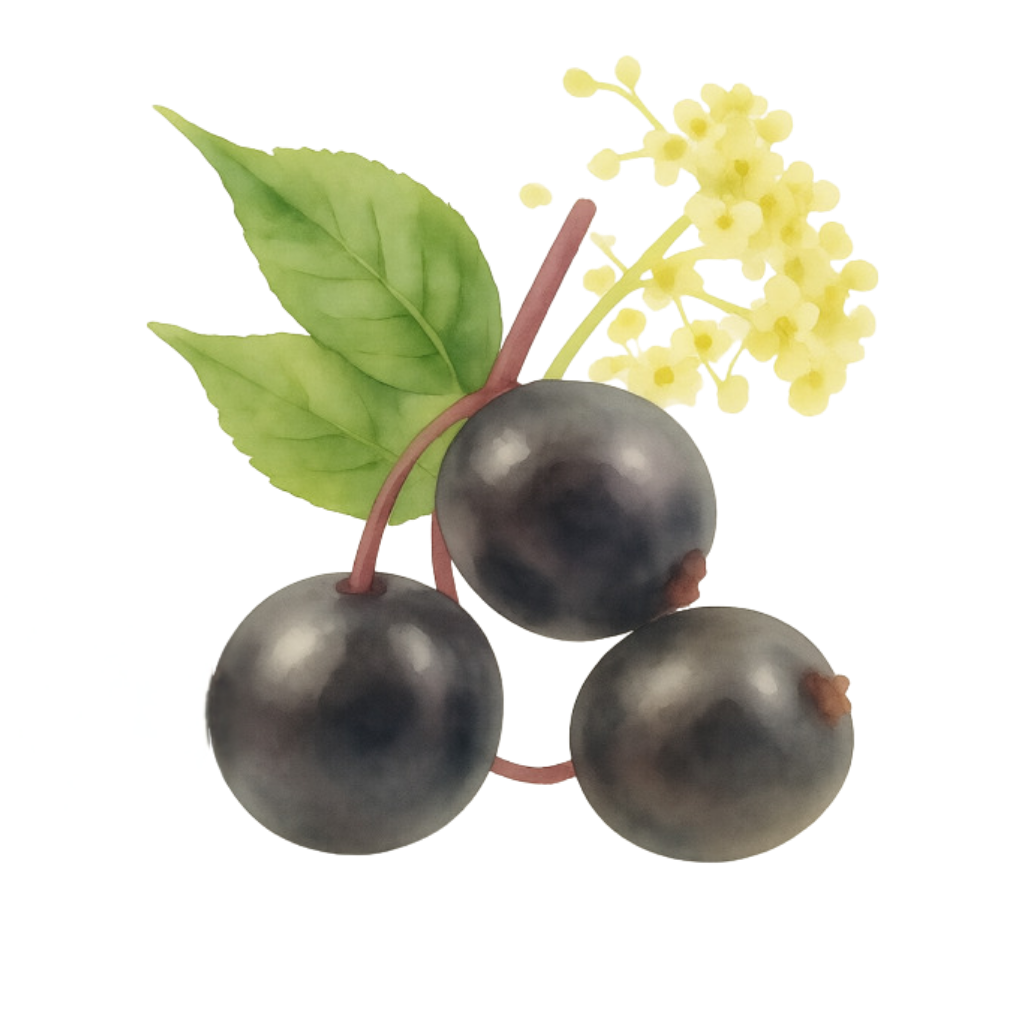
American Elderberry
Sambucus canadensisVarieties
Adams
York
Nova
Johns
Bob Gordon
13–16° BrixWyldewood
Botanical View
- Leaves are opposite, odd-pinnately compound, up to about 30 cm long, with typically 5 to 11 leaflets (commonly 7). Leaflets are ovate to elliptic-lanceolate, roughly 5-15 cm long and 2-6 cm wide, with sharply serrate margins, an acuminate tip and a short stalk; the lower pair is sometimes further divided. Foliage is bright to dark green and rather thin/papery, glabrous or nearly so above and paler beneath, with an unpleasant odor when crushed. Fall color is an undistinguished yellow. Leaves emerge relatively late in spring.
- Numerous erect, arching canes arise from a spreading crown, giving a many-stemmed shrub habit. Young stems (canes) are green to tan, more or less angled, and conspicuously dotted with raised lenticels; they enclose a thick, soft, white pith. Older stems develop gray-brown, warty, lightly furrowed bark. Wood is soft, weak and brittle, and canes are relatively short-lived, so growers commonly manage plantings by pruning or coppicing older canes. Berries are borne on the current season's growth as well as older wood.
- The root system is relatively shallow and fibrous, with most active water- and nutrient-absorbing roots concentrated in roughly the upper 15-25 cm of soil. Plants spread aggressively by rhizomes and root suckers, producing new canes some distance from the parent crown and forming dense colonies or thickets where suckers are not removed. This vigorous vegetative spread makes elderberry easy to propagate by division but also potentially weedy; because rooting is shallow, plants are sensitive to drought.
- The inflorescence is a large, flat-topped to slightly rounded, compound cyme (corymb-like) held above the foliage, typically about 10-25 cm (up to ~30 cm) across, with roughly 5 main rays. It bears numerous small flowers, each about 5-6 mm in diameter, with a five-lobed creamy-white corolla, five stamens and an inferior ovary. Flowers are perfect (bisexual), sweetly to musky fragrant, and rich in pollen and nectar. After pollination the cluster develops into a drooping cyme of small (about 3-6 mm) purple-black berry-like drupes, each containing 3-5 seeds.
- Flowers are perfect (hermaphroditic) and insect-pollinated (entomophilous). The species is largely self-compatible and self-fruitful, so a single clone can set fruit, but yields and fruit set are generally improved by cross-pollination between two or more genotypes, indicating a mixed mating system. Because individual flowers within and among the large clusters open over an extended period and different clones often bloom asynchronously, growers are advised to interplant multiple cultivars in close proximity to maximize fruit set. Reproduction is both sexual (seed) and extensively clonal via rhizomes/suckers.
- Pollination is chiefly by insects attracted to the abundant pollen and nectar of the open flower clusters, including bees (honey bees, bumble bees and native solitary bees), syrphid and other flies, small beetles, and other generalist flower visitors. Some wind pollination and self-pollination also occur. The species is valued as a pollinator and beneficial-insect resource; its berries are subsequently dispersed by birds and mammals.
- Elderberry tolerates a wide range of soils, from sands to clays and from occasionally wet to seasonally dry, but grows best in deep, fertile, moist yet well-drained soils high in organic matter. It naturally occupies rich bottomland and streamside soils. A slightly acidic reaction is preferred, roughly pH 5.5-6.5 (tolerating up to near-neutral or mildly alkaline). Good moisture retention with adequate drainage is ideal; it withstands brief flooding better than many fruit crops but does not thrive in permanently waterlogged or very droughty sites.
- Because it is shallow-rooted and moisture-demanding, elderberry needs consistent water; roughly 2.5-5 cm (1-2 inches) of water per week is recommended during dry periods, commonly supplied by drip irrigation, and drought stress is poorly tolerated. It responds well to nitrogen and organic matter: guidelines suggest nitrogen applied a few weeks after planting in the establishment year and mature plantings receiving on the order of 60-80 lb N per acre annually, with phosphorus and potassium adjusted to soil tests. Mulching and slow-release or split (fertigated) nitrogen applications help on leaching-prone soils.
- Most easily and commonly propagated vegetatively (clonally). Hardwood cuttings taken from dormant one-year-old canes in late winter (two or more nodes, often treated with IBA rooting hormone) root readily in 4-6 weeks; softwood/greenwood cuttings taken during the growing season before flowering root under mist. Plants are also propagated by digging rooted suckers, rhizome/stolon divisions and layering. Seed propagation is possible but slow and variable: seeds are dormant and require scarification and warm-then-cold stratification (or extended cold stratification), giving low, uneven germination, so it is generally avoided for cultivar production.
- American elderberry is highly heterozygous and largely outcrossing, so seedlings segregate widely and do not come true to type, varying in vigor, yield, ripening time, fruit size and quality. This genetic variability is valuable for selection and breeding but makes seed unsuitable for reproducing named cultivars; consequently commercial and named material is multiplied clonally by cuttings or division to preserve identity. Wild populations show broad phenotypic diversity, from which most current cultivars were selected.
- Numerous cultivars exist, nearly all selected from wild plants rather than from controlled crosses. Older eastern North American selections include 'Adams' ('Adams No. 1' and 'No. 2'), 'York', 'Johns', 'Kent', 'Nova', 'Scotia' and 'Victoria' (developed in New York and Nova Scotia in the 20th century). The modern University of Missouri / Center for Agroforestry program (from 1997) selected and released wild-derived clones such as 'Bob Gordon', 'Wyldewood', 'Ranch' and 'Ozark' (with others like 'Marge', 'Pocahontas' and 'Ozone' in trials), chosen for high yield, fruit quality, adaptability and suitability for mechanized harvest.
- Cultivar development has relied mainly on selection of superior wild plants. The first named cultivars, 'Adams No. 1' and 'No. 2', were selected in New York in the early 20th century (around the 1920s), followed by other New York and Nova Scotia (Kentville) selections such as 'York', 'Johns', 'Nova', 'Kent', 'Scotia' and 'Victoria' through the mid-1900s. Interest revived with the University of Missouri Elderberry Improvement / Center for Agroforestry program begun in 1997 (led by Andrew Thomas, Patrick Byers and colleagues), which evaluated dozens of wild accessions and released improved clones ('Wyldewood' 2010, 'Bob Gordon' 2011, 'Ranch', 'Ozark'), advancing yield, fruit quality and mechanical-harvest suitability; controlled hybridization breeding remains at an early stage.