Back to Fruitpedia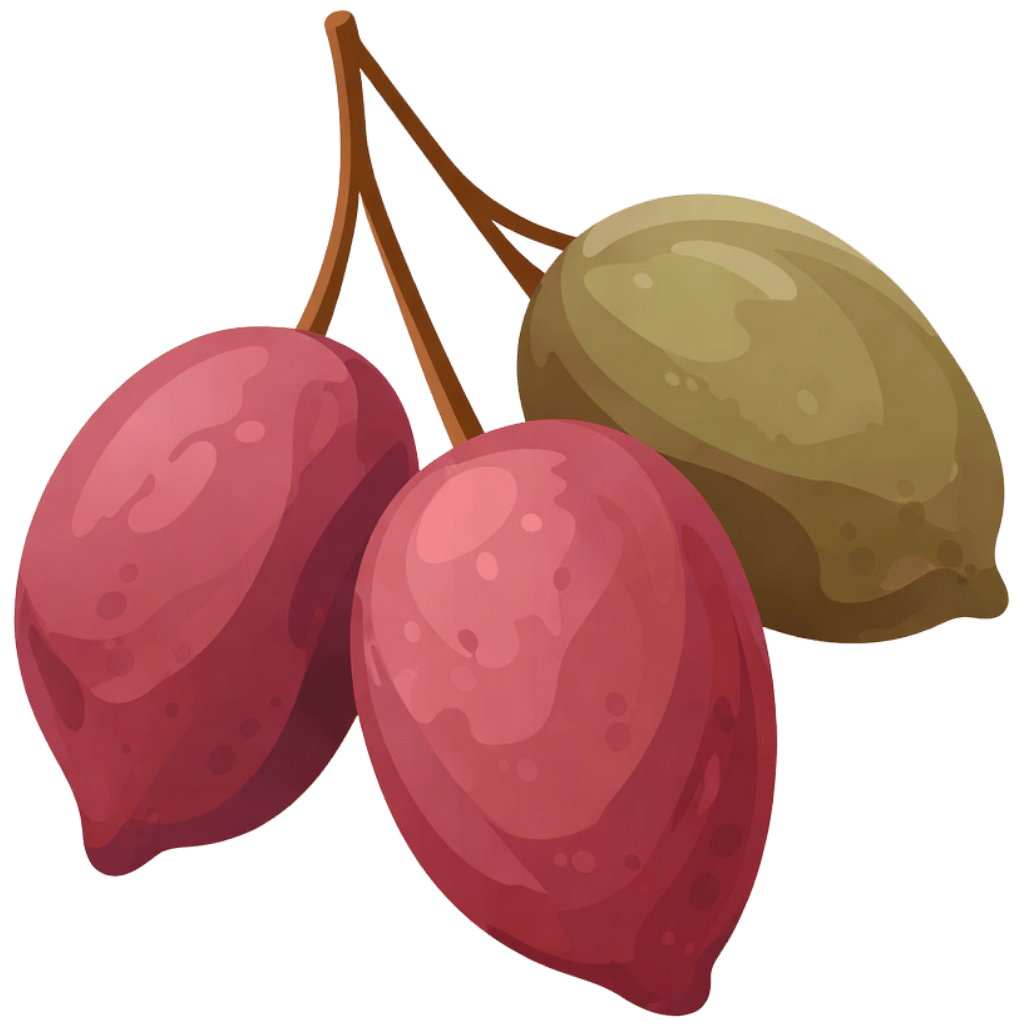
Tropical almond
Terminalia catappaBotanical View
- Leaves are alternate, obovate, with short petioles, and are spirally clustered at the tips of the branches. They are large, 15–36 cm long by 8–24 cm wide, leathery and glossy, dark green above and paler beneath. The species undergoes a foliage change once or twice a year (region-dependent): before shedding, leaves turn bright scarlet, dark red, dark purplish-red, or yellow, giving a conspicuous seasonal display; leaf loss allows the tree to tolerate one or two annual dry seasons. New foliage that follows leaf drop is described as lustrous, silky and purplish. (Orwa et al. 2009, World Agroforestry Centre)
- The trunk is erect and often buttressed at the base, bearing bark that is grey-brown and becomes rough with age. The crown architecture is defined by horizontal to slightly ascending branch whorls ("storeys") spaced 1–2 m apart, producing the characteristic pagoda shape. The wood is red, elastic, cross-grained, seasons well and works easily, with a density of 450–720 kg/m³ at 12% moisture content; it is used for construction, boat-building and similar purposes. The trunk is also a source of gum, and the bark is astringent, containing 9–23% tannin. (Orwa et al. 2009, World Agroforestry Centre)
- The species develops an extensive, vast root system that binds together sand and poor soils, which is why it is valued for erosion control and coastal stabilization/reclamation of sandy areas. The tree is known to form natural root grafts. In seedlings, the taproot grows rapidly; nursery protocols specify that seedlings must be transplanted promptly (around 6 weeks after sowing, once cotyledons unfold) to avoid damaging this fast-growing taproot. (Orwa et al. 2009, World Agroforestry Centre; RNGR/USDA Forest Service propagation protocol)
- Flowers are borne in slender, unbranched axillary spikes (racemes) 15–25 cm long. Individual flowers are small, greenish-white, apetalous (lacking petals) and slightly fetid-smelling, with 10–12 conspicuous stamens as the main visible feature. (Orwa et al. 2009, World Agroforestry Centre)
- Terminalia catappa is andromonoecious: the majority of flowers on a spike are functionally male and are borne toward the apex, while a smaller number of hermaphroditic (bisexual) flowers occur lower on the spike; some spikes bear only male flowers. The recorded ratio of male to hermaphroditic florets is approximately 16:1. The species possesses an effective self-incompatibility system, which, together with the andromonoecious flower arrangement, promotes outcrossing. (Orwa et al. 2009, World Agroforestry Centre, citing Oni & Adedire 1985, Forestry Research Paper)
- Pollination is carried out by a broad range of insect visitors, documented across the orders Coleoptera (beetles), Diptera (flies), Hemiptera (true bugs), Hymenoptera (bees, wasps, ants) and Lepidoptera (moths/butterflies). (Orwa et al. 2009, World Agroforestry Centre)
- Terminalia catappa is well adapted to sandy and rocky coasts and flourishes on oolitic limestone. It reaches greatest natural concentration on sands and loamy sands but is also found on silts, loams and clays. Soil pH is usually neutral to moderately alkaline and base-rich, though the species will also tolerate strongly acid soils. Good drainage is required where it is grown on clay soils. Its natural habitat lies just inland from ocean beaches, near river mouths and on coastal plains — typically flat terrain that may include dunes or rocky bluffs. (Orwa et al. 2009, World Agroforestry Centre)
- On poor soils, fertilizer application prior to planting is recommended to support establishment, after which growth (initially slow) accelerates. In nursery production, frequent, consistent watering is required during germination and the 4–6 week establishment period following transplant; the active growth phase (about 8–10 months) benefits from light fertilizer application, and a final ~4-week hardening-off phase with reduced watering frequency is used to prepare seedlings for dry post-outplanting conditions. Adequate daily watering has also been documented to help reduce incidence of Paecilomyces seedling die-back disease. (Orwa et al. 2009, World Agroforestry Centre; RNGR/USDA Forest Service propagation protocol)
- Propagation is primarily by seed. Fruits are best collected from the ground rather than picked from the tree, since undropped fruit may be immature; some loss to seed predation should be expected. Collected fruits are soaked in water overnight to soften the outer skin (exocarp), which is then removed to expose the fibrous layer beneath; light tapping with a mallet can help speed germination. Seeds are sown 1–2 cm deep in sand, vermiculite or potting media under partial shade, with germination occurring over roughly 20–60 days (one source reports about 70% germination within 20 days following a 24-hour cold-water soak). Germination is epigeal. Seedlings must be transplanted promptly, around 6 weeks after sowing once cotyledons unfold, to avoid damage to the rapidly elongating taproot. The species will coppice as a seedling or sapling, though it is not considered a strong sprouter, and it exhibits natural pruning characteristics. Unshelled seed retains fair viability when stored dry and cool for weeks to months. (RNGR/USDA Forest Service propagation protocol; Orwa et al. 2009, World Agroforestry Centre)
- Seeds show orthodox storage behaviour: they remain viable for a long time and germinate readily, including after floating in seawater for long distances (an important mechanism of natural coastal/island dispersal). Seed count varies by source: approximately 150–860 seeds/kg is reported, with about 24 fresh fruits and roughly 160 nuts/kg noted separately. Historic taxonomic literature (World Flora Online/IPNI) records several described botanical varieties within the species — var. macrocarpa Hassk., var. rhodocarpa Hassk. and var. chlorocarpa Hassk. — reflecting natural variability in fruit size and colour, though these names are of limited current taxonomic use. (Orwa et al. 2009, World Agroforestry Centre; World Flora Online/IPNI)
- No formally registered, widely recognized horticultural cultivars of Terminalia catappa are documented in the botanical/agroforestry literature reviewed. The species is propagated almost exclusively from wild or naturalized seed sources rather than selected clonal lines. Older taxonomic literature records natural botanical varieties (var. macrocarpa, var. rhodocarpa, var. chlorocarpa Hassk.) reflecting variation in fruit size/colour, and red-leaved ornamental forms are traded informally, but none constitute a standardized, registered cultivar. An Economic Botany review (Morton 1985) explicitly characterized the species' nut as "worthy of improvement," indicating that no significant formal breeding/selection programme had been undertaken as of that assessment. (Orwa et al. 2009, World Agroforestry Centre, citing Morton 1985, Economic Botany 39(2):101-112; World Flora Online/IPNI)
- Terminalia catappa has not undergone significant formal domestication or breeding improvement; it remains essentially a wild-type species propagated from seed collected from naturalized or planted populations rather than from selected breeding lines. Its long history of human-assisted spread is due to its value as a multipurpose tree (edible kernel, oil, timber, tannin/dye, shade and ornamental use, coastal stabilization) rather than genetic selection, which accounts for its very wide pantropical naturalized distribution today across Africa, Asia, Australia, the Pacific, and the Americas. Economic Botany literature (Morton 1985) specifically flagged the species' nut/kernel as "worthy of improvement," underscoring the historical absence of a dedicated breeding programme. (Orwa et al. 2009, World Agroforestry Centre, citing Morton JF 1985, "Indian almond (Terminalia catappa), salt-tolerant, useful, tropical tree with 'nut' worthy of improvement," Economic Botany 39(2):101-112)