Back to Fruitpedia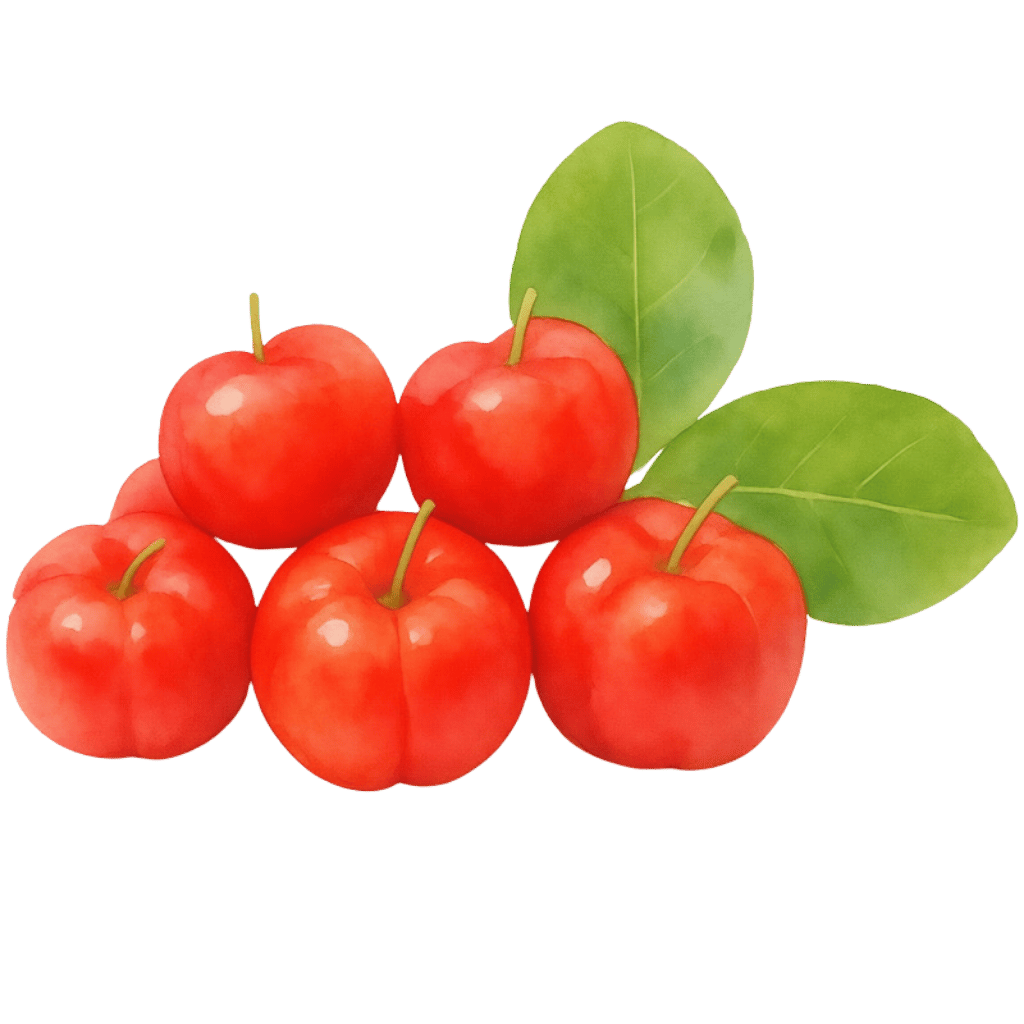
Barbados cherry
Malpighia emarginataVarieties
Florida Sweet
7–10° BrixManoa Sweet
Hawaiian Queen
B-17
BRS 237 Roxinha
BRS 236 Cereja
Botanical View
- Leaves are evergreen, opposite, and simple, with elliptic, oblong, obovate, or narrowly oblanceolate blades about 2-7 cm (3/4-2 3/4 in) long. Young leaves bear fine, white, silky hairs that can be irritating to the skin on contact; mature leaves become hairless (glabrous), dark green, and glossy. Source: Morton, J.F., "Fruits of Warm Climates," Purdue University Center for New Crops (hort.purdue.edu/newcrop/morton/barbados_cherry.html); UF/IFAS Extension St. Lucie County, "Growing Barbados Cherry in Florida" (blogs.ifas.ufl.edu/stlucieco/2025/08/20/growing-barbados-cherry-in-florida).
- Acerola is a bushy shrub or small tree reaching up to about 6 m (20 ft) in height, with a short trunk to about 10 cm (4 in) in diameter. Branches are more or less erect or spreading and drooping, and are minutely hairy (pubescent) when young. Trees reach horticultural maturity at about 3 years of age; light, regular pruning is used to stimulate new growth and improve air circulation, and the species tolerates heavier rejuvenation pruning when needed. Source: Morton, J.F., "Fruits of Warm Climates," Purdue University Center for New Crops (hort.purdue.edu/newcrop/morton/barbados_cherry.html); UF/IFAS Extension St. Lucie County, "Growing Barbados Cherry in Florida" (blogs.ifas.ufl.edu/stlucieco/2025/08/20/growing-barbados-cherry-in-florida).
- The root system consists of a main taproot (pivotante) together with lateral roots, most of which are concentrated in the upper soil layers, giving the tree a relatively shallow, spreading root architecture that can make plants susceptible to lodging in strong winds and to root rot in poorly drained soils. EMBRAPA notes that grafted seedlings develop a more vigorous, more deeply penetrating taproot system that explores a greater soil volume than own-rooted (ungrafted) plants, providing better anchorage. Source: EMBRAPA, "Boas práticas agrícolas para produção orgânica de acerola" (infoteca.cnptia.embrapa.br/infoteca/bitstream/doc/1144495/1/Documento253-AnaLucia-2022-AINFO-1-1.pdf).
- Flowers are borne in sessile or short-peduncled axillary (occasionally terminal) cymes, typically in clusters of about 3-5. Individual flowers are roughly 2-2.5 cm wide, with 5 pink-to-lavender or white-pink, spoon-shaped, fringed (fimbriate-margined) petals, 10 stamens, 6-10 glands on the calyx, and a superior, 3-lobed, 3-locular ovary topped by 3 curved styles/fused carpels. Fruits (drupes) typically develop in pairs or groups of three from each inflorescence. Sources: Morton, J.F., "Fruits of Warm Climates," Purdue University Center for New Crops (hort.purdue.edu/newcrop/morton/barbados_cherry.html); Pl@ntUse (Pl@ntNet-project) botanical compilation, Malpighia emarginata (plantuse.plantnet.org/en/Malpighia_emarginata), summarizing published Malpighiaceae floristic descriptions.
- Acerola flowers are short-lived (open for about a single day), and both self- and cross-pollen grains are capable of setting fruit if pollination occurs on the day of anthesis, indicating the species is largely self-compatible, though fruit set and yield are markedly improved by insect (bee) cross-pollination, and commercial orchards depend heavily on adequate pollinator activity for consistent, heavy fruit set. Source: "Pollination requirements of West Indian cherry (Malpighia emarginata) and its putative pollinators, Centris bees, in NE Brazil," Journal of Agricultural Science, Cambridge University Press (cambridge.org/core/journals/journal-of-agricultural-science/article/abs/pollination-requirements-of-west-indian-cherry-malpighia-emarginata-and-its-putative-pollinators-centris-bees-in-ne-brazil).
- Flowers are pollinated primarily by oil-collecting solitary bees of the genus Centris (family Apidae, tribe Centridini), which are attracted to floral oils and pollen; Centris tarsata has been identified as the main pollinator in northeastern Brazil, and Centris (Heterocentris) analis is notable for its abundance and rapid acceptance of trap-nests, making it a manageable pollinator for orchards. Introducing nesting sites for Centris analis has been shown to significantly increase acerola yield (by roughly 1,798 kg/ha in field trials) regardless of variety. General bees are also reported as frequent flower visitors and principal pollinators in Florida plantings. Sources: "Searching for a Manageable Pollinator for Acerola Orchards: The Solitary Oil-Collecting Bee Centris analis," Journal of Economic Entomology (bioone.org/journals/journal-of-economic-entomology, and pubmed.ncbi.nlm.nih.gov/19253645); "Pollination requirements of West Indian cherry (Malpighia emarginata) and its putative pollinators, Centris bees, in NE Brazil," Journal of Agricultural Science, Cambridge (cambridge.org/core/journals/journal-of-agricultural-science); Morton, "Fruits of Warm Climates" (hort.purdue.edu/newcrop/morton/barbados_cherry.html).
- Acerola grows well on a range of well-drained soils, including limestone, marl, and clay, provided drainage is good; it performs poorly in waterlogged or heavy, poorly drained soils, which favor root rot given its shallow root system. A minimum soil pH of about 5.5 is recommended, with incorporation of lime to a depth of about 20 cm (8 in) or more where soils are more acidic; UF/IFAS Extension similarly recommends slightly acidic to neutral soil, pH about 6.0-7.0, with organic matter incorporation on sandy soils. Source: Morton, J.F., "Fruits of Warm Climates," Purdue University Center for New Crops (hort.purdue.edu/newcrop/morton/barbados_cherry.html); UF/IFAS Extension St. Lucie County, "Growing Barbados Cherry in Florida" (blogs.ifas.ufl.edu/stlucieco/2025/08/20/growing-barbados-cherry-in-florida).
- EMBRAPA production-system guidance covers liming and fertilization scheduling (soil-analysis-based NPK and micronutrient applications split across the year) and irrigation as key inputs for reaching full productivity, reported at up to about 40 kg of fruit per plant from the third year onward under well-managed irrigated systems in Brazil's semi-arid Northeast. University of Florida IFAS Extension recommends young trees receive balanced fertilizer at roughly 2-month intervals starting at about 1/4 lb per application, increasing as trees mature to 2-4 lb applied three times per year (up to about 15 lb/tree/year for mature trees), with iterative adjustment based on foliage response on sandy Florida soils; incorporation of organic matter is recommended on sandy soils. Young trees need irrigation two to three times per week for the first two to three months after planting; mature trees are moderately drought-tolerant but produce better fruit set and yield with regular irrigation during dry periods, which is essential for reaching commercial yields in semi-arid production regions. Sources: EMBRAPA, "Sistema produtivo da acerola (Malpighia emarginata)" (ainfo.cnptia.embrapa.br/digital/bitstream/doc/1162484/1/Sistema-produtivio-acerola-2023.pdf); UF/IFAS Extension St. Lucie County, "Growing Barbados Cherry in Florida" (blogs.ifas.ufl.edu/stlucieco/2025/08/20/growing-barbados-cherry-in-florida).
- Vegetative propagation (stem cuttings, air layering, and grafting) is the standard commercial method because it fixes desirable clonal traits and produces earlier, more uniform fruiting than seedlings. Cuttings of branches about 6-12.5 mm thick and 20-25 cm long can root in about 60 days under appropriate conditions; rooting of herbaceous cuttings can be improved with auxin treatments such as indolebutyric acid, as demonstrated in Brazilian trials with the 'CAMB-06' and 'APU-04' selections. EMBRAPA notes that grafted (enxertadas) plants develop a more vigorous, deeper (pivotante) root system exploring a larger soil volume than own-rooted plants, improving anchorage. Seed propagation is used mainly for rootstock production or breeding, given its variable and often low germination. Sources: Morton, J.F., "Fruits of Warm Climates," Purdue University Center for New Crops (hort.purdue.edu/newcrop/morton/barbados_cherry.html); "Rooting of herbaceous cuttings of Malpighia emarginata D.C. (CAMB-06 and APU-04 selections)...," Revista Brasileira de Fruticultura, SciELO (scielo.br/j/rbf); EMBRAPA, "Boas práticas agrícolas para produção orgânica de acerola" (infoteca.cnptia.embrapa.br/infoteca/bitstream/doc/1144495/1/Documento253-AnaLucia-2022-AINFO-1-1.pdf).
- Because flowers are not obligately self-pollinated and orchards rely on insect cross-pollination, seed-grown (seedling) acerola populations are highly heterozygous and genetically variable, producing offspring that differ widely in vigor, fruit size, fruit quality, and vitamin C content from the parent plant. Seed germination itself is also inconsistent, with reported germination rates ranging from as low as about 5% up to about 50% depending on seed lot and conditions. This variability is the primary reason commercial and breeding programs rely on clonal (vegetative) propagation of selected genotypes rather than seed propagation for orchard establishment. Source: Morton, J.F., "Fruits of Warm Climates," Purdue University Center for New Crops (hort.purdue.edu/newcrop/morton/barbados_cherry.html).
- Because seedlings are highly heterozygous, commercial plantings rely on clonally propagated cultivars. Florida: 'Florida Sweet' (selected 1956; upright habit, large, thick-skinned, semi-sweet fruit) and the 'B' series of Puerto Rican selections such as 'B-15' and 'B-17' (high ascorbic-acid content and productivity). Brazil (EMBRAPA-released or -recommended clones): 'BRS Sertaneja' (EMBRAPA Semiárido, released 1998, selected for irrigated areas of the Submédio São Francisco region, fruit vitamin C above 1,500 mg/100 g); 'BRS 236' / 'Cereja' (EMBRAPA Agroindústria Tropical, recommended for the Chapada do Apodi region, Ceará); other selected clones used in research and orchards include 'CAMB-06' and 'APU-04'. Cultivar development in Brazil has been based mainly on mass selection within introduced germplasm and commercial-orchard populations rather than controlled hybridization. Sources: EMBRAPA (embrapa.br/busca-de-publicacoes 131942, 131943); Morton, "Fruits of Warm Climates" (hort.purdue.edu/newcrop/morton/barbados_cherry.html); ResearchGate/SciELO propagation trials citing 'CAMB-06' and 'APU-04' selections (Revista Brasileira de Fruticultura, scielo.br/j/rbf).
- Malpighia emarginata is native to the Yucatan Peninsula of Mexico, Central America, the Caribbean and northern South America, where it has been used since pre-Columbian times. It was introduced to Puerto Rico in the 1940s, where the discovery of its exceptionally high ascorbic-acid content (documented by Asenjo & Freire de Guzman, 1946) triggered wide interest; the University of Puerto Rico subsequently developed and released seedling selections. Brazil received its first seeds/seedlings from Puerto Rico and Florida in the early 1950s (commonly cited as 1955), and acerola became a commercial crop there from the 1980s onward. EMBRAPA (Empresa Brasileira de Pesquisa Agropecuária) established institutional breeding programs from the 1990s: EMBRAPA Semi-Árido (Petrolina, PE) assembled a germplasm collection of introduced accessions and used mass selection to release the cultivar 'BRS Sertaneja' in 1998 for irrigated areas of the Brazilian Northeast, while EMBRAPA Agroindústria Tropical (Fortaleza, CE) began mass selection from a commercial orchard in 1995, leading to clones such as 'BRS 236' ('Cereja'). An Active Germplasm Bank for acerola was formalized in Brazil in 1998 to conserve genetic diversity for continued breeding. A chromosome-scale reference genome assembly for acerola was published in 2024, supporting future marker-assisted breeding. Sources: EMBRAPA cultivar release documents (embrapa.br/busca-de-publicacoes 131942, 131943); Morton, J.F., "Fruits of Warm Climates" (Purdue University Center for New Crops, hort.purdue.edu/newcrop/morton/barbados_cherry.html); PMC6098779 (Journal review, ncbi.nlm.nih.gov/pmc/articles/PMC6098779).