Back to Fruitpedia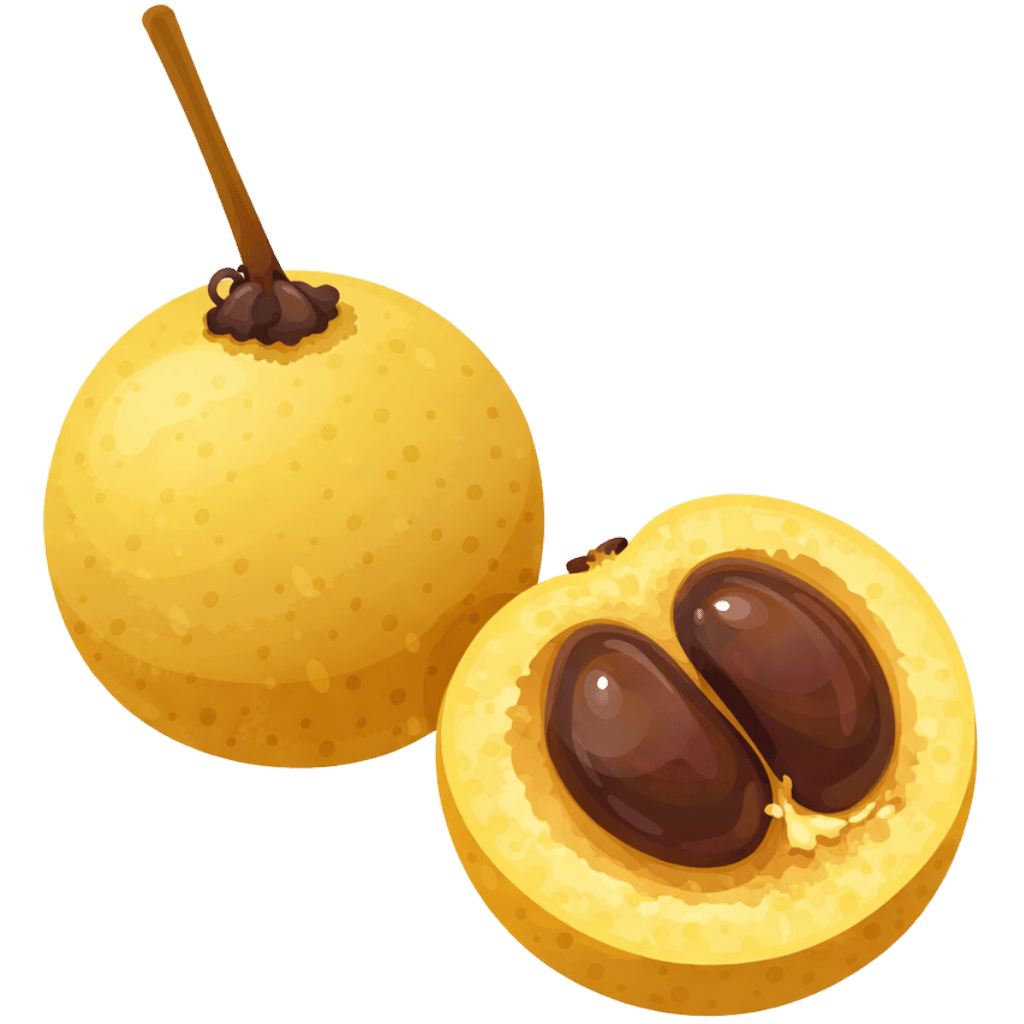
Mammee apple
Mammea americanaVarieties
Redland
Waimanalo
Botanical View
- Leaves are opposite, simple, glossy, leathery (coriaceous), dark green and broadly elliptic to obovate, up to about 20 cm (8 in) long and 10 cm (4 in) wide, with entire margins and a dense, shiny appearance. The foliage juice produces an indelible stain. Cones made of the leaves have traditionally been used to shield tobacco seedlings from root-attacking insects.
- The trunk (bole) is short and straight, up to roughly 1 m (occasionally to 1.2 m) in diameter, bearing ascending branches. The bark is rich in tannins and, when wounded, exudes a pale-yellow, aromatic gummy latex that has been used as an insecticide.
- The tree develops large, spreading lateral roots, which contribute to soil stabilization and erosion control.
- Flowers are borne singly or in small clusters of two or three on short axillary stalks (peduncles). Each flower is fragrant and white to cream, about 2.5-4 cm (1-1.5 in) across, with 2 sepals and 4 to 6 free (unfused) petals roughly 1.5-2 cm long, and numerous orange stamens. Pistillate and hermaphrodite flowers bear a superior ovary of 2 carpels with 2 locules and axile placentation.
- The species is functionally polygamo-dioecious: staminate (male), pistillate (female) and hermaphrodite flowers may occur together or on separate trees. Staminate flowers have numerous functional stamens with a nonfunctional carpel, while pistillate/hermaphrodite flowers have a functional ovary. Some trees produce predominantly female flowers and fruit heavily, whereas predominantly male trees set little or no fruit, so both sexes are generally needed for reliable cropping.
- Pollination is by insects; the fragrant, nectar-bearing flowers attract bees (including honeybees) and butterflies, with hummingbirds also reported as flower visitors.
- Prefers deep, rich, well-drained soil, ideally sandy loam with a pH near 6-6.5 (tolerating about 5.5-8), but is adaptable and also succeeds on shallow, sandy terrain and limestone soils.
- Árvore rústica, que exige pouca ou nenhuma atenção cultural depois de estabelecida, à parte a proteção contra o frio.
- Usually propagated by seed, which should be sown fresh; seeds germinate in about 2 months or less (reported germination rates up to ~97%), and seedlings reach 40-50 cm within 3-5 months under light shade before out-planting. Seedling trees begin fruiting in about 6-8 years in Mexico and 8-10 years in the Bahamas. Vegetative propagation by grafting/budding is preferred to fix sex and quality and to bring earlier bearing; greenwood cuttings with bottom heat can also be used.
- Seedlings are variable: because of the polygamo-dioecious breeding system a proportion of seed-grown trees prove to be predominantly male and fruit poorly or not at all, and fruit quality also varies, which is why superior selections are propagated vegetatively. Each fruit contains 1 to 4 large seeds (single-seeded in small fruits, up to four in large ones).
- A few named or local selections exist (sources note "some named varieties" and regional types distinguished mainly by fruit size, flesh texture and freestone vs. clingstone character), but no widely standardized commercial cultivar series has been established.
- Native to the Greater Antilles (West Indies) and adjacent northern South America, the species was among the fruit trees noted by early European chroniclers in the Caribbean and was spread by cultivation through tropical America, West Africa and Southeast Asia. It remains largely a dooryard/semi-cultivated fruit with little formal breeding; improvement has been limited to selection of superior fruiting (largely female) individuals rather than organized breeding programs.