Back to Fruitpedia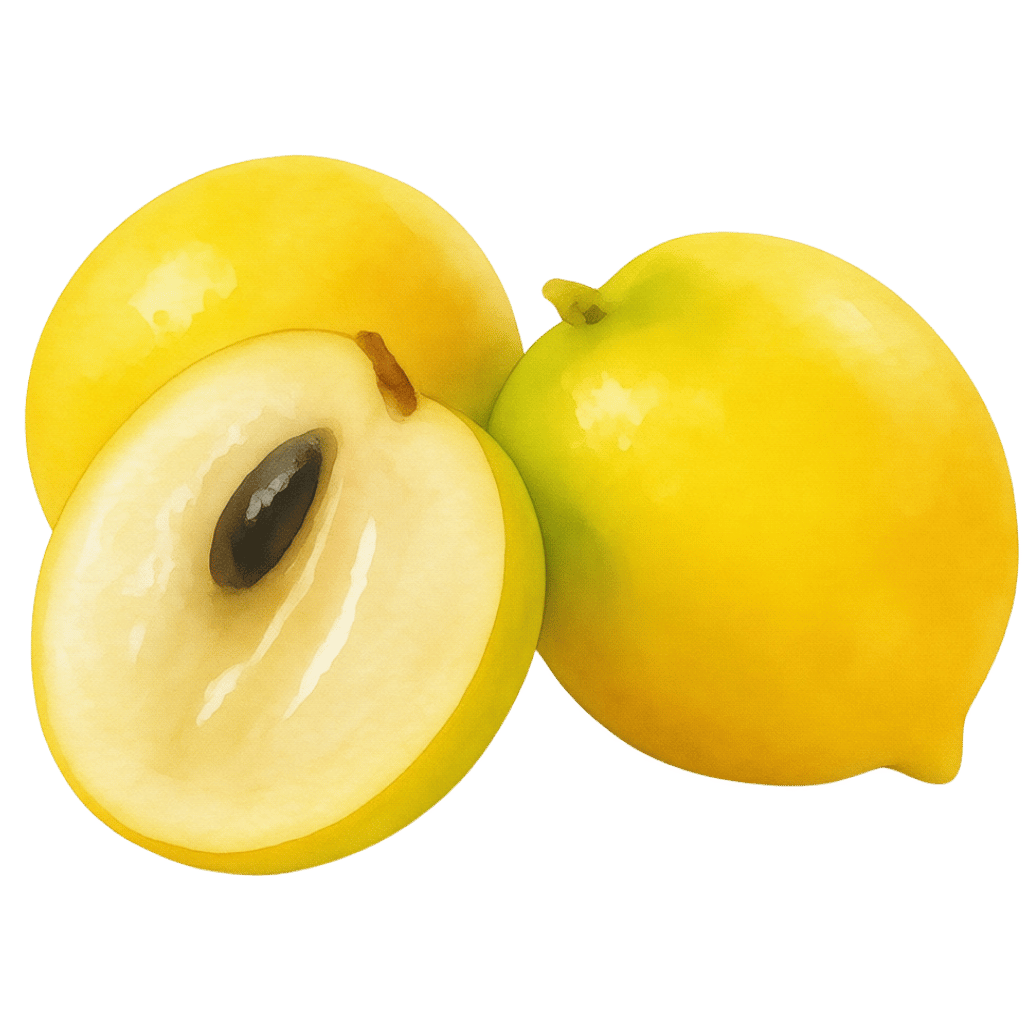
Abiu
Pouteria caimitoVarieties
Gigante do Solimões
Tikuna
Z2
Z4
Botanical View
- Leaves are simple, alternate and arranged spirally (often clustered toward branch tips), oblong to elliptic or obovate, 10–20 cm long and 3.5–6.5 cm wide, with a short petiole. They are leathery (coriaceous), entire-margined, glossy dark green above and paler beneath, and evergreen. Young growth and the leaf undersides may bear fine latex-bearing tissue characteristic of the Sapotaceae.
- The trunk and branches carry grey to brown bark that is smooth on young trees, becoming rough, fissured and cracked with age. The wood is dense, heavy and hard and is used locally as construction timber. Stems, like all vegetative parts, contain abundant white latex that flows when the bark is cut.
- Abiu develops a deep root system that improves soil aeration and contributes to organic-matter recycling. The deep-rooting habit aids anchorage and drought tolerance once established, though the tree performs best where deep, well-drained soils allow full root development. Detailed published data on root architecture are limited.
- Flowers are borne in the leaf axils (or scars) along thin shoots, either singly or in small fascicled clusters of 2–5; a vigorous branch may carry up to about 280 flowers. Individual flowers are small, with 4–5 white to greenish, somewhat cylindrical petals, and are sessile to short-stalked. The blooms open in the morning and each remains open for roughly one to two days.
- Flowers are hermaphroditic (bisexual, both sexes in one flower). The species is largely self-compatible (self-fertile), so isolated trees will set fruit, but cross-pollination between trees tends to improve fruit set and produce larger fruit.
- Pollination is primarily entomophilous (insect-mediated), carried out mainly by small bees and other insects visiting the morning-opening flowers. Because each flower is open only briefly, effective insect activity during the short receptive window is important for good fruit set.
- It grows best on deep, fertile, free-draining loam and clay soils rich in organic matter, moderately acid to neutral, with an optimum pH of about 5.5–7.0 (tolerant of roughly 5.5–7.5). It tolerates a range of soil types but suffers chlorosis on alkaline or limestone soils, has poor tolerance of salt spray and soil salinity, and is killed by saline conditions. Amending poorer soils with manure or compost is beneficial.
- Pre-bearing trees (years 1–3) are commonly fertilized with an N:P:K ratio around 10:4:8, shifting to about 11:8:12 for bearing trees applied in roughly four applications per year. Deficiencies of zinc, iron and boron are common and are corrected with targeted foliar or soil treatments. In drier or seasonal climates supplemental irrigation is needed to sustain growth and fruiting, as the tree favors consistent soil moisture while requiring good drainage.
- Propagation is most often by seed, which germinates readily in about 2–10 days (some seeds germinate within the fruit); however seed viability is very short, lasting only 1–2 days under dry conditions, making seeds difficult to store. To preserve superior cultivar traits, vegetative methods are used, chiefly top-wedge grafting and budding, and also air layering. Seedling trees typically begin fruiting at about 3 years, with substantial yields by around 5 years.
- Each fruit contains 1–4 ovate, dark-brown seeds that separate easily from the pulp. Seed-grown (seedling) trees show considerable variation in fruit size, shape, seed number and quality, which is why named cultivars are propagated vegetatively for consistency. Wild germplasm is noted to have markedly greater stress resistance than cultivated germplasm and thus higher breeding value.
- Selected cultivars include Z4 (large, round, single-seeded) and Z2 (large, ellipsoid, 1–2 seeds), which are among the recommended varieties, along with other selections such as Z1, Z3, Inca Gold, Cape Oasis, Gray, T25 and T31. These are maintained by grafting or budding to preserve fruit quality.
- Abiu has a long history of use by indigenous peoples of the western and central Amazon and has been carried into cultivation across the Amazon basin (especially Pará, Brazil) and to Cuba, the Philippines, Southeast Asia, Australia and other tropical regions. Formal breeding has been limited; improvement to date rests mainly on selection of superior seedling clones (named cultivars propagated by grafting). Genomic resources, including a sequenced chloroplast genome, and the recognition that wild germplasm carries stronger stress resistance and higher breeding value point to future directed improvement.